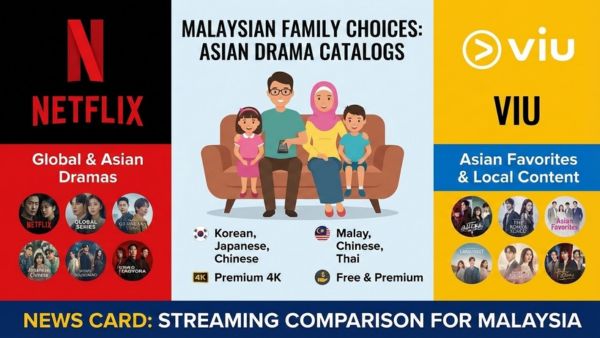
In the Malaysian streaming landscape of 2026, the question is rarely "Which app is better?" and more "Which combination of apps justifies my monthly budget?" While Netflix remains the global titan of high-fidelity Western content, Viu has carved out an immovable stronghold in Malaysia by mastering the art of the Asian simulcast.
Choosing between them requires looking past the brand names and analyzing your specific household habits. Are you binging Squid Game sequels in 4K on a 65-inch OLED, or are you catching up on the latest Korean variety shows during a rainy commute from Kelana Jaya? Here is the definitive breakdown of Netflix vs Viu for the Malaysian viewer.
1. Catalogue Strategy: Global Breadth vs. Regional Depth
The Netflix Approach: "The Everything Store"
Netflix's strength lies in its massive investment in original IP. From Stranger Things to their growing library of high-budget Korean "Originals" (like The Glory or Gyeongseong Creature), they sell a polished, exclusive experience. In Malaysia, Netflix also serves as a vital hub for local cinema, often hosting Malaysian box office hits shortly after their theatrical run.
- Best For: Hollywood blockbusters, award-winning documentaries, high-production K-dramas, and households with children who need a massive library of dubbed animation.
The Viu Approach: "The Simulcast Specialist"
Viu does not try to be everything to everyone. Instead, it focuses on being the fastest. For K-drama fans, Viu is the gold standard because they frequently secure "First-on-Viu" rights, dropping episodes with professional subtitles as early as eight hours after the original Korean telecast. Their library is also more diverse across the Asian continent, featuring a significant volume of Japanese anime, Chinese dramas, and Thai "lakorns."
- Best For: Hardcore K-drama fans who can't wait, variety show enthusiasts, and viewers who prefer a wider selection of pan-Asian content including Hong Kong and Thai productions.
2. The 2026 Pricing Reality in Malaysia
The days of "cheap" streaming have shifted as platforms prioritize profitability. Netflix, in particular, has updated its pricing structure to combat password sharing, while Viu has leaned into aggressive local partnerships.
| Feature | Netflix Malaysia | Viu Malaysia |
|---|---|---|
| Entry Price | RM18.90 (Mobile) | Free (Ad-supported) |
| Standard Plan | RM49.90 (1080p) | RM21.90 (Full HD) |
| Premium/Family | RM62.90 (4K + HDR) | Multiple device support included |
| Account Sharing | RM13 per extra member | Up to 5 devices (standard) |
The "Extra Member" Factor
For many Malaysians, Netflix's RM13 "Extra Member" fee (for those living outside your primary household) has changed the math. If you were previously splitting a Premium plan with friends in different condos, your bill has likely spiked. Viu, conversely, remains more flexible with its multi-device login, making it a more "split-friendly" option for friend groups.
3. Local Ecosystems: Telco Bundles and E-Wallets
In Malaysia, you should rarely pay the "sticker price" for Viu. The platform has mastered local integration better than almost any other streamer.
- Maxis & CelcomDigi: Both telcos frequently offer Viu Premium as a "Mega Add-on" for as low as RM3.90 to RM9.90 per month when tied to a 12-month contract.
- The HBO Max Bundle: A significant development in late 2025/early 2026 is the HBO Max + Viu bundle. For roughly RM33.90, Malaysians can now bridge the gap between Western prestige TV (HBO) and Asian dramas (Viu) under a single billing umbrella.
- Astro Integration: If you are an Astro subscriber, Viu is often bundled into "Entertainment" or "Asian" packs at no extra cost, whereas Netflix is typically reserved for the higher-tier "Platinum" or "Entertainment Plus" packs.
4. User Experience: Tech vs. Utility
Subtitle Quality and Localization
Netflix arguably has the best subtitle engine in the world. Their "Bahasa Melayu" tracks are often expertly localized, capturing nuances that machine translation misses. Viu's subtitle quality has improved drastically, and they often provide multiple language options (English, BM, Simplified Chinese) that feel culturally resonant for the Malaysian audience.
Offline Downloads and Commuting
Both apps support offline downloads, but Netflix's "Smart Downloads" (which automatically delete a finished episode and download the next one when you hit Wi-Fi) is a godsend for commuters on the Kelana Jaya LRT line. Viu's download interface is functional but lacks that extra layer of automation.
The "Free" Tier
This is where Viu wins for casual viewers. You can access a massive amount of content on Viu for free if you are willing to sit through ads. Netflix has moved away from free trials or ad-supported tiers in Malaysia, making it a "pay-to-play" exclusive club.
5. The Verdict: Which one fits your sofa?
Choose Netflix if: You want a "prestige" experience. You value 4K HDR quality, you love Western documentaries, and you want a single app that the whole family (from toddlers to grandparents) can use safely with robust parental controls.
Choose Viu if: You are an Asian drama specialist. You follow trending K-dramas in real-time, you enjoy variety shows like Running Man, and you want the most "bang for your buck" via telco bundles or the HBO Max combo.
Pro Tip: Many Malaysian households now use Netflix as their "Permanent" subscription and cycle through Viu, iQIYI, or WeTV only when a specific show they want to watch is airing. This "Rotation Strategy" is the best way to fight subscription fatigue in 2026.
Explore more in our Asian streaming analysis or check out the latest C-drama app shortlists for your next binge-watch.